

Table of Contents
- Best Outdoor Refrigerators at a Glance
- Built-in Outdoor Refrigerator Options
- Outdoor Refrigerator Brands: Quality Comparison
- Weatherproof Outdoor Refrigerator Cabinet Materials
- Temperature Control and Cooling Performance
- Installation, Ventilation, and Long-Term Ownership
- Warranty, Durability, and Climate-Specific Guidance
- Frequently Asked Questions
Last Updated: October 12, 2026
Best Outdoor Refrigerators at a Glance
In an outdoor kitchen, the refrigerator gets overlooked until you can't keep drinks cold in July heat, that's when the difference between a cheap outdoor fridge and a purpose-built unit becomes obvious.
The challenge isn't finding an outdoor refrigerator, it's finding one that won't fail after a season.
The best outdoor refrigerators share three non-negotiable traits: 304-grade stainless steel that resists corrosion, digital temperature controls that hold steady in extreme heat, and proper ventilation clearances that prevent compressor failure. Beyond that, your choice depends on space, capacity, and whether you're building a compact bar or a full entertaining station.
Below, we've tested five models that deliver real performance outdoors, each handling different use cases with honest trade-offs so you can pick the right fit.
| Model | Price | Capacity | Best For | Key Strength |
|---|---|---|---|---|
| Blaze 15-Inch | $899 | 74 cans | Small spaces | Space-efficient design |
| Glass Front Cooler | $1,946 | 84 cans + 22 wine bottles | Entertainment | Visibility & capacity |
| Premium Compact | $1,574 | 4.2 cu ft | Island integration | Organized storage |
| FireMagic Outdoor Rated | $5,999 | 5.1 cu ft | Professional grade | High-capacity cooling |
| Black Diamond LH | $1,237 | 4 cu ft | Flexible layouts | Left-hinge option |
Built-in Outdoor Refrigerator Options
Built-in units integrate into outdoor kitchen islands and custom cabinetry. They're for permanent installation, not portable use, and demand proper ventilation planning before you cut any holes in your countertop.

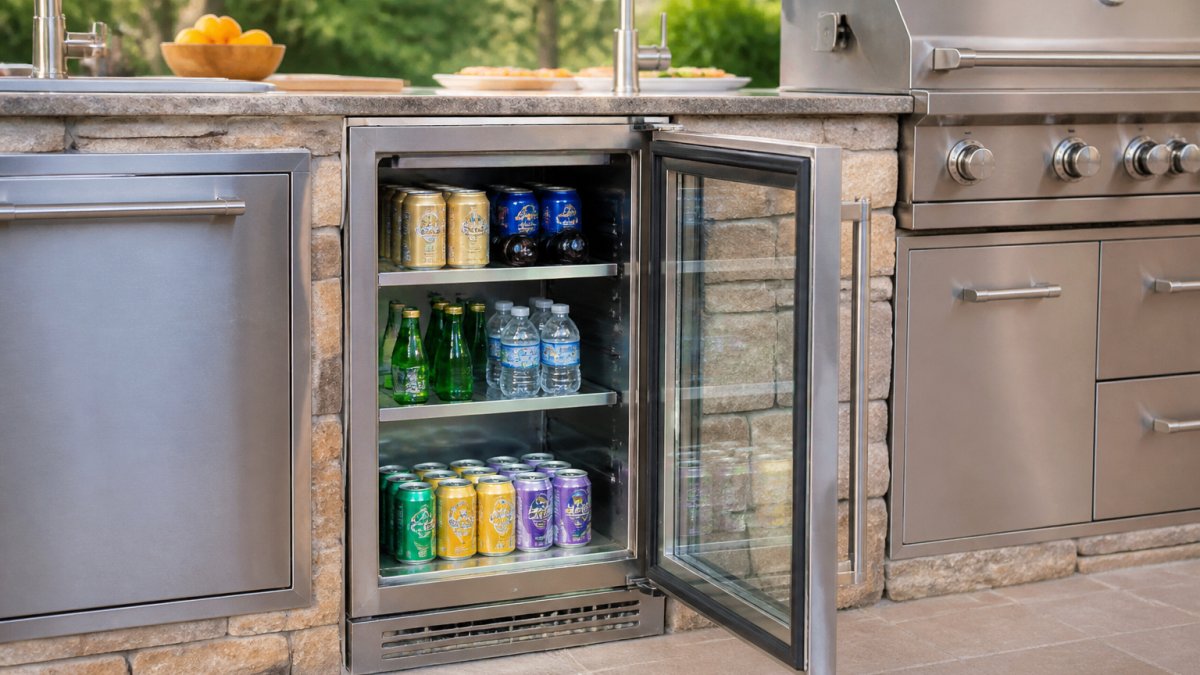
Blaze 15-Inch: Space-Saving Performance
The Blaze 15-Inch Outdoor Refrigerator solves a real problem: you want cold drinks at your outdoor bar but don't have 24 inches of counter space. At 15 inches wide, it fits tight layouts without compromising cooling power.
The 304-grade stainless steel cabinet resists rust and UV degradation, white LED lighting lets you grab drinks at night, and a digital thermostat gives precise control when outdoor heat spikes above 95 degrees. It holds 74 beverage cans despite its slim footprint.
What works: The narrow profile doesn't sacrifice storage or durability.
What doesn't: At 15 inches, it's not designed for mixed entertaining where you need wine bottles, food storage, and beverages. If you're hosting 20 people, this fills up fast.
Glass Front Cooler: Entertainment-Ready Capacity
The Glass Front Outdoor Beverage Cooler flips the script: instead of hiding drinks behind a solid door, the glass front lets guests see exactly what's available.

At 24 inches wide, it holds 84 cans and 22 wine bottles, or 42 cans and 62 wine bottles for a wine station. Glass shelving is customizable, swap in beech wood or keep glass for visibility, and digital temperature control with white LED lighting keeps drinks cold and visible at dusk.
The real advantage surfaces during entertaining: guests see everything, and the glass door means you're not constantly opening and closing, which preserves cooling efficiency. 304-grade stainless steel matches professional kitchen standards.
Premium Compact Refrigerator: Organized Island Integration
The Premium Compact Refrigerator SS - LH targets outdoor kitchen islands where you need more than drinks. This 4.2 cubic foot unit includes a moisture-regulated crisper drawer for herbs and vegetables plus a vertical can dispenser track.

The left-hinge configuration (LH) suits island layouts where a right-opening door would block workflow. Motion-activated interior lighting illuminates in low light, and an integrated keyed lock secures premium beverages during gatherings.
The Echelon-style handle aligns visually with Fire Magic Grills, maintaining consistency across a coordinated outdoor kitchen.
What matters most: Proper ventilation clearance. The compressor demands unobstructed airflow on rear and side panels. Before cutting your island cabinetry, verify that your frame allows 2-3 inches of clearance on all sides. Skipping this step causes thermal overload and premature failure.
FireMagic Outdoor Rated: High-Capacity Professional Grade
The FireMagic Outdoor Rated Refrigerator is the heavy hitter. At 5.1 cubic feet and $5,999, it's built for serious entertaining or commercial-adjacent outdoor kitchens, with a 304 stainless steel cabinet that resists UV degradation and corrosion.
A double-tap digital thermometer displays real-time temperature without opening the door, fixed shelving is calibrated for standard can and bottle layouts, and a keyed lock protects inventory during events.
At 119 pounds, this unit demands a rigid, level floor support within your outdoor kitchen framing. The compressor base is heavier than smaller models, so structural planning matters. Shipping dimensions are 27 inches wide by 30.75 inches deep by 34.25 inches tall, verify your installation space before ordering.
Black Diamond: Flexible Configuration
The Black Diamond Outdoor Refrigerator LH delivers 4 cubic feet in a left-hinge configuration that works when standard right-hinged units clash with island obstacles. Its squared-edge stainless steel exterior resists UV exposure, temperature swings, and coastal humidity.
The signature Fire Magic handle pattern ensures visual consistency with matching grills, a factory-mounted keyed lock and automatic interior illumination handle security and usability, and at 78 pounds it's manageable through tight entryways.
This unit bridges compact and premium: serious storage without the FireMagic's five-figure price tag. The trade-off is slightly lower capacity and a more basic feature set, for most custom island builds, that's the right balance.
Outdoor Refrigerator Brands: Quality Comparison
The brands in our lineup, Blaze, FireMagic, and Black Diamond, approach outdoor refrigeration differently. Understanding those differences helps you pick the right match.
Blaze focuses on value and space efficiency. Their units use 304-grade stainless steel and digital controls at accessible price points. Best for homeowners who want reliable cooling without premium pricing.
FireMagic builds for professional-grade performance: heavier construction, larger capacities, and higher price tags for serious entertaining or outdoor kitchens that rival indoor ones. Their units integrate with Fire Magic grill systems for a fully coordinated setup.
Black Diamond occupies the middle ground: durable 304 stainless steel, reasonable pricing, and flexible configurations like left-hinge options make them practical for custom island builds where standard right-hinge units don't fit.
All three use 304-grade stainless steel, which is the industry standard for outdoor durability. Lower-grade stainless (like 430-grade) corrodes faster and isn't worth the savings.
Weatherproof Outdoor Refrigerator Cabinet Materials
304-grade stainless steel isn't just marketing language, it's a material specification that determines how long your refrigerator survives outdoors.
Blaze 15-Inch Outdoor Refrigerator →
304 stainless contains 18% chromium and 8% nickel, which creates a passive oxide layer that resists corrosion. When that layer is scratched or damaged, it self-heals in the presence of oxygen.
Aluminum and powder-coated steel are cheaper upfront but fail faster. Aluminum oxidizes and develops white corrosion spots. Powder coating chips under temperature cycling and UV exposure, leaving bare metal vulnerable to rust.
The best outdoor refrigerators use squared-edge cabinet construction rather than rounded edges. Squared edges shed water more effectively and resist damage from weather exposure.
Hinges and handles matter too. Stainless steel hardware resists corrosion better than chrome-plated or painted alternatives.
Temperature Control and Cooling Performance
Outdoor refrigerators face challenges indoor units never encounter: direct sun can push cabinet temperatures above 140 degrees, and hot climates regularly exceed 100 degrees.
The compressor is the heart of cooling performance, and all units in our lineup use proven designs rated for outdoor conditions.
Many outdoor refrigerator failures aren't caused by defective units but by improper installation: builders cut cabinetry too tight, leaving insufficient clearance, so the compressor overheats, cycles constantly, and fails within a season.
Before cutting any holes in your island, verify the manufacturer's clearance requirements. Most outdoor refrigerators need 2-3 inches of unobstructed space on rear and side panels. Some require more. Confirm these specs match your actual installation space.
Installation, Ventilation, and Long-Term Ownership
Installation mistakes kill more outdoor refrigerators than manufacturing defects. Here's what matters.
Ventilation clearance is non-negotiable. The compressor generates heat that must escape; blocked vents cause thermal overload, constant cycling, and failure within months.
Level, rigid floor support prevents vibration and compressor damage. A wobbly island flexes under temperature cycling, stressing compressor mounts and refrigerant lines.
Electrical access must be planned. Outdoor refrigerators need dedicated circuits. Don't run them on extension cords or shared circuits. Voltage fluctuations stress the compressor and shorten lifespan.
Seasonal use affects longevity. If you're closing your outdoor kitchen for winter, drain the refrigerant lines and protect the unit from freezing.
Maintenance is straightforward but essential. Clean condenser coils quarterly. Check door seals annually. Wipe down stainless steel monthly in coastal climates. These simple steps prevent most failures.
The real long-term cost isn't the purchase price, it's avoiding expensive repairs or premature replacement.
Warranty, Durability, and Climate-Specific Guidance
That warranty means nothing if you don't follow installation requirements. Improper ventilation, inadequate electrical circuits, or structural instability voids coverage. Read the manual before cutting any cabinetry.
Climate considerations:
In hot, dry climates (Southwest, high desert), cooling performance is the primary concern. The FireMagic and Glass Front Cooler handle sustained heat better than compact models.
In humid climates (Southeast, coastal areas), corrosion resistance matters most: 304-grade stainless steel is non-negotiable.
In temperate climates with seasonal use, focus on winterization: drain refrigerant lines before freezing temperatures arrive and cover units stored through winter.
According to the American Society of Heating, Refrigerating and Air-Conditioning Engineers, outdoor cooling equipment rated for specific ambient temperature ranges performs reliably only within those parameters.
When you're ready to build an outdoor kitchen that works year-round, the refrigerator is where reliability pays dividends.
Shop all our outdoor refrigeration options and get expert guidance on sizing, installation, and climate-specific setup.
Frequently Asked Questions
What is the best outdoor refrigerator for an outdoor kitchen?
The best outdoor refrigerator depends on your space and entertaining needs. The Blaze 15-Inch ($899) works well for compact layouts and holds 74 cans. The Glass Front Outdoor Beverage Cooler ($1,946) suits frequent entertainers with its 84-can capacity and wine-bottle storage. For professional-grade capacity, the FireMagic Outdoor Rated ($5,999) delivers 5.1 cubic feet and integrates seamlessly with Fire Magic grill systems. All feature 304-grade stainless steel and digital temperature control for reliable cooling in outdoor conditions.
What features matter most in a professional outdoor refrigerator?
Look for 304-grade stainless steel construction, which resists UV degradation and coastal humidity. Digital thermostats with temperature displays let you monitor cooling without opening the door. Adequate ventilation clearance (typically 2-3 inches on sides and rear) prevents compressor overload in high-heat conditions. Keyed locks protect contents during large gatherings. Interior lighting and organized shelving improve usability. Built-in models require proper installation with unobstructed airflow; freestanding units offer placement flexibility.
What is the difference between built-in and freestanding outdoor refrigerators?
Built-in refrigerators integrate into custom kitchen islands and cabinetry, offering a seamless, professional appearance and permanent installation. They require precise cutout dimensions and proper ventilation clearance during installation. Freestanding models sit independently on a level surface, offering placement flexibility and easier relocation. Built-in units typically cost more but create a unified outdoor kitchen aesthetic. Freestanding options suit renters or those uncertain about permanent outdoor kitchen investment.
Can a regular indoor refrigerator be used in an outdoor kitchen?
No. Standard indoor refrigerators lack weatherproof construction and fail in outdoor temperature extremes. Outdoor-rated units feature corrosion-resistant 304-grade stainless steel, sealed compressors designed for high ambient temperatures, and UV-resistant finishes. Indoor models exposed to sun, humidity, and temperature swings typically fail within one season. Outdoor refrigerators maintain cooling performance in 95+ degree heat and resist salt spray in coastal climates, making them essential for long-term durability.
What makes a weatherproof outdoor refrigerator cabinet last longer?
304-grade stainless steel is the gold standard for outdoor refrigeration because it resists corrosion, UV degradation, and salt spray better than lower-grade materials. Sealed compressors and reinforced door gaskets prevent moisture intrusion. Proper installation with 2-3 inches of clearance on all sides ensures unobstructed airflow, preventing thermal overload that shortens compressor life. Regular cleaning to remove salt residue and debris extends cabinet longevity.


