

Table of Contents
- Why Outdoor Refrigerators Fail: The Core Problem
- Compressor Overheating and Startup Failures
- Outdoor Refrigerator Not Cooling Properly
- Temperature Fluctuations and Ambient Weather Exposure
- Outdoor Refrigerator Ventilation Requirements and Airflow Issues
- Outdoor Refrigerator Troubleshooting: Electrical and Thermostat Problems
- Outdoor Refrigerator Winter Storage and Seasonal Shutdown
- Repair Versus Replacement: When to Call a Professional
- Frequently Asked Questions
Last Updated: October 17, 2026
Why Outdoor Refrigerators Fail: The Core Problem
Outdoor refrigerators fail for reasons indoor models never face. Why do outdoor refrigerators fail? Usually environmental stress, design limitations, and maintenance gaps owners don't anticipate.
An outdoor fridge operates in conditions that would destroy a kitchen refrigerator within weeks. Heat, humidity, temperature swings, salt air, and direct sun make the compressor work harder, degrade seals faster, and destabilize the thermostat. Understanding these failure points helps you prevent them, or know when repair beats replacement.
Here are the seven most common causes of outdoor refrigerator failure, how to diagnose each, and what to do about it.

Compressor Overheating and Startup Failures
The compressor pumps refrigerant through the system to create cooling, and in outdoor units it faces brutal conditions.
Compressor overheating happens when ambient temperatures climb above 95 degrees. Most outdoor refrigerators are rated to 110 degrees. In direct sun or poor airflow, the compressor works overtime, its motor strains, and eventually it fails.
Startup failures are equally frustrating: you flip the switch and the compressor won't kick on. This usually signals one of three issues:
- Power supply problem, The outlet isn't delivering power
- Thermostat malfunction, The control board can't signal the compressor to start
- Compressor failure, The motor itself is dead or stuck
A compressor that won't start after sitting idle for months (especially over winter) sometimes needs a hard reset. Unplug the unit for five minutes, then plug it back in. If it still won't start, the compressor has likely failed and needs replacement.
Outdoor Refrigerator Not Cooling Properly
The most common complaint we hear: the fridge runs, but drinks aren't getting cold.
An outdoor refrigerator not cooling properly points to one of four culprits. First, check the thermostat: dial it to maximum cooling and wait 24 hours. If temperatures drop, the thermostat was simply set too low.
Second, inspect the door seal. If the rubber gasket around the frame is cracked, torn, or no longer sealing tightly, cold air leaks out constantly and the compressor can't keep up. Replace a damaged seal.
Third, look for ice buildup. Frost on the evaporator coils blocks airflow and kills cooling, usually because the defrost cycle isn't working or humidity inside the cabinet is too high. Wipe away visible ice and monitor whether it returns.
Fourth, check for refrigerant leaks. Damaged or corroded lines let refrigerant escape, and you'll see oily residue around connection points. This requires professional repair, since refrigerant handling is regulated and dangerous to attempt yourself.
Temperature Fluctuations and Ambient Weather Exposure
Temperature swings, ice-cold one hour and warm the next, signal thermostat or sensor problems.
The thermostat uses a sensor to read internal temperature and cycle the compressor. When the sensor fails, the thermostat can't regulate: it may freeze everything or not cool at all. Replacing the sensor usually fixes it.
Ambient weather exposure is the challenge indoor models never face. Direct sun heats the cabinet, rain and humidity corrode seals and electrical connections, and freezing temperatures can damage the compressor if the unit isn't winterized.
Hot, cold, or freezing weather extremes stress every component. Here's what happens:
- Hot weather (90+ degrees): Compressor works constantly, overheats, and fails early
- Cold weather (below 40 degrees): Refrigerant thickens, compressor struggles to pump it, and cooling stops
- Freezing temperatures (below 32 degrees): Liquids inside freeze and expand, damaging lines and seals
An outdoor fridge designed for year-round use (like those from Urban Man Caves) has heavy insulation and a compressor rated for wide temperature ranges. Indoor models moved outside fail quickly in extreme conditions.
Outdoor Refrigerator Ventilation Requirements and Airflow Issues
Poor ventilation is a silent killer. The compressor and condenser coils generate heat that must escape; if air can't circulate, heat builds up, the compressor runs longer, and the unit fails earlier.
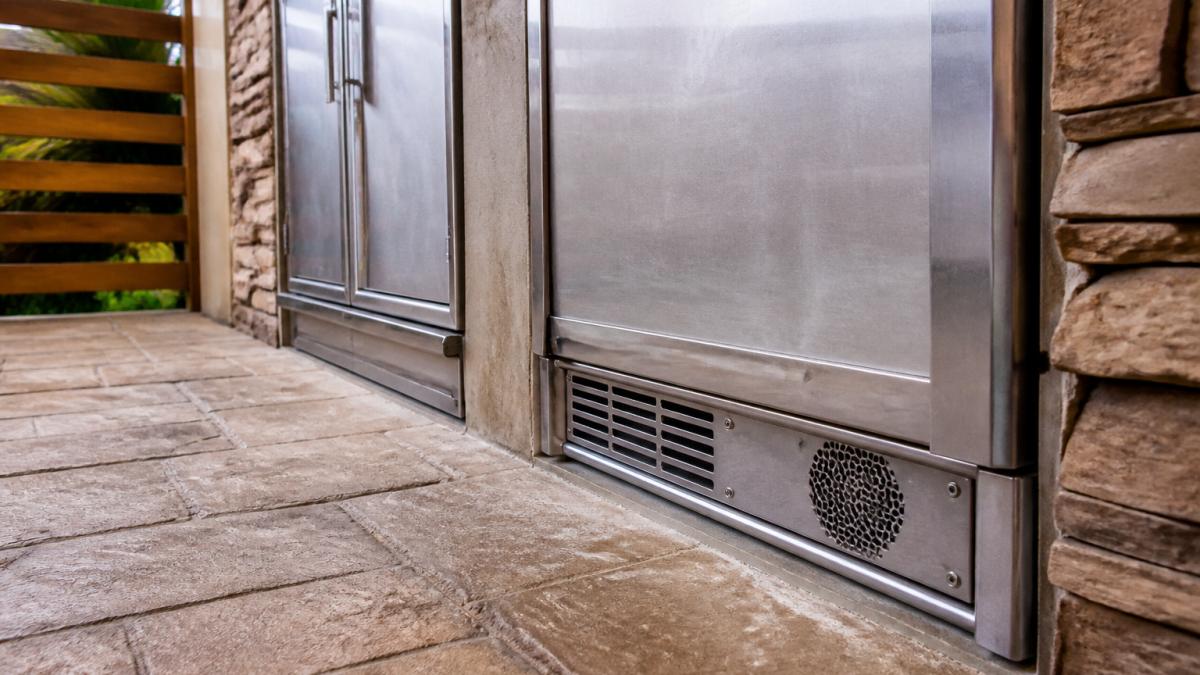
Outdoor-rated refrigerators are built differently: sealed or coated control boards, corrosion-resistant fasteners and finishes, a compressor rated for wider ambient temperatures, and a condenser and fan sized to reject heat in hot conditions.
Clearance is the next checkpoint. Manuals vary, but built-in outdoor units commonly need roughly 2 to 4 inches at the rear and sides and 1 to 2 inches above, with more room in a cabinet or under a counter.
Vent orientation matters as much as clearance. Front-venting units pull air in and push heat out through face grilles, suiting built-in applications only if those grilles aren't blocked by cabinet doors, towels, or stored items. Rear-venting units need open space behind them.
Ambient conditions compound the problem. Direct sun adds heat load the condenser must reject, and a unit against a south- or west-facing wall or in an unshaded enclosure runs harder than one in shade. Shade, a vented enclosure, and correct clearances together do more for compressor life than any single maintenance task.
Finally, keep the air path clean. Dust, pollen, and debris clog condenser fins and the evaporator filter, forcing the compressor to work harder. Check coils and filter monthly during heavy use, vacuum or brush the fins, and rinse or replace the filter as the manual directs.
Outdoor Refrigerator Troubleshooting: Electrical and Thermostat Problems
Start here when your outdoor refrigerator fails completely.
Blaze 15-Inch Outdoor Refrigerator →
Step 1: Check the power supply. Verify the outlet has power by plugging in another device (a phone charger works). If the outlet is dead, check your circuit breaker. Flip the breaker off and back on. If it trips again immediately, there's an electrical fault, call a professional.
Step 2: Inspect the power cord. Look for cuts, fraying, or damage. Water exposure can damage the cord. If the cord is visibly damaged, don't use the unit, replace it.
Step 3: Test the thermostat. Set it to the coldest setting and listen for the compressor to kick on within 30 seconds. If you hear nothing, the thermostat may be faulty. Try unplugging the unit for 5 minutes and plugging it back in to reset the control board.
Step 4: Look for error codes. Some outdoor refrigerators display error codes on a digital panel. Check your manual for what they mean. Common codes indicate sensor failure, compressor problems, or door seal issues.
Step 5: Feel the condenser coils. Locate the coils (usually on the back or side of the unit). They should be warm to hot. If they're cold or cool, the compressor isn't running. If they're extremely hot (too hot to touch), the compressor is overworking due to poor ventilation or a thermostat stuck in "always on" mode.
These steps help you pinpoint whether the problem is electrical, mechanical, or environmental.
Outdoor Refrigerator Winter Storage and Seasonal Shutdown
Winter storage prevents cold-weather damage, but the details matter. Where temperatures regularly drop below 40 degrees, you have two options: winterize the unit and keep it available, or shut it down completely for the season. Either way, follow a procedure rather than improvising.
Seasonal shutdown procedure. Empty the refrigerator completely, including door bins and ice trays. Unplug it and let it come to room temperature. Clean the interior with mild detergent, rinse, and dry thoroughly, since leftover moisture promotes mold and odor. Clean the condenser coils and filter.
Winterizing instead of shutting down. If your unit is rated for cold-weather operation and you want to keep it running, confirm the manufacturer's stated minimum operating temperature; running below that minimum can damage the compressor. Keep the door closed, maintain clearance so snow doesn't block vents, and clear snow and ice after storms. Never pour hot water on the cabinet or coils to melt ice.
Never leave an indoor-rated refrigerator running outdoors through freezing weather. The compressor and refrigerant system are not designed for it, and the failure often shows up as a compressor that will not start in spring.
Food safety after a failure or outage. If the refrigerator warmed up from a power loss, failed compressor, or unplanned shutdown, assess the food before keeping it. A refrigerator held above 40 degrees for more than about two hours should have perishable food discarded. Check the internal temperature with a thermometer rather than guessing.
Spring restart checks. Before powering up, inspect the door seal for cracks or stiffness, look for rust or corrosion on the cabinet and fasteners, check the cord and plug for damage, and confirm vents and coils are clear. Plug the unit in, set it to its normal temperature, and let it run empty for several hours before restocking.
Repair Versus Replacement: When to Call a Professional
Repair versus replacement depends on age, cost, and the specific failure.
Repair makes sense when:
- The unit is less than 5 years old
- The repair cost is less than 50% of the replacement price
- The failure is a single component (thermostat, door seal, fan motor)
Replacement makes sense when:
- The unit is older than 7 years
- The compressor has failed (this is the most expensive repair)
- Multiple components are failing simultaneously
- Repair costs exceed 60% of a new unit's price
A compressor replacement on a mid-range outdoor refrigerator can cost $400-$800. If your unit is already 8 years old and the compressor fails, buying a new refrigerator is often the smarter choice.
Professional repair technicians can diagnose refrigerant leaks, replace compressors, and handle electrical issues safely. Refrigerant handling requires EPA certification and special equipment (the EPA). Never attempt to recharge or repair refrigerant lines yourself.
For outdoor refrigerators from Urban Man Caves, like the Blaze 15-Inch Outdoor Refrigerator or the Premium Outdoor Rated 4.9 cu. ft. Stainless Steel Fridge Series II, check your warranty documentation before paying for repairs.

Outdoor refrigerators fail from harsh conditions, skipped maintenance, and components reaching end of life. The good news: most failures are preventable. Keep your unit in shade, ensure proper ventilation, clean filters regularly, and winterize it in cold climates. When failure does happen, knowing whether to repair or replace saves money and frustration. Urban Man Caves stocks outdoor refrigerators built for year-round entertaining, with the durability and support to back them up. Shop all products and get expert guidance on selecting the right unit for your climate and space.
Frequently Asked Questions
Why is my outdoor fridge not cooling?
Your outdoor refrigerator not cooling properly typically stems from compressor failure, refrigerant leaks, blocked ventilation, or thermostat malfunction. Start by checking that the unit is plugged in and powered on, then verify the thermostat is set correctly. Ensure airflow vents are clear of debris and the compressor isn't overheating from ambient temperatures above 95°F. If these basic checks don't resolve it, the compressor may need professional service or replacement.
Can extreme heat make an outdoor refrigerator stop working?
Yes. Most outdoor refrigerators are rated for ambient temperatures up to 95-110°F. When the outdoor temperature exceeds this range, the compressor works harder to maintain cooling and can overheat, causing it to shut down or fail entirely. Placing your outdoor refrigerator in shade, ensuring proper ventilation clearance on all sides, and maintaining adequate airflow around the unit helps prevent heat-related failure.
How should I store my outdoor refrigerator during winter?
Before winter, clean the interior and exterior thoroughly, then leave the door open slightly to prevent mold and odor buildup. If your climate experiences freezing temperatures, turn off the unit and drain any remaining water. Store it in a sheltered location or cover it with a breathable tarp to protect against snow and ice without trapping moisture. Never seal the unit completely, as condensation can damage internal components.
What does outdoor-rated refrigerator design mean?
Outdoor-rated refrigerators are built with 304-grade stainless steel, enhanced insulation, and sealed components to withstand direct sun, rain, and temperature swings that regular indoor models cannot handle. They feature reinforced compressors designed for higher ambient temperatures, improved door seals to maintain cooling efficiency, and ventilation systems that account for outdoor installation. Premium models like the Blaze 15-Inch Outdoor Refrigerator include digital temperature controls and extended warranties specifically for outdoor durability.


