

Last Updated: November 3, 2026
Quick Summary
Keep your gas fire pit in line of sight whenever you use the remote, and watch the burner until you see a steady flame. If ignition fails, turn the remote off and wait at least 5 minutes for gas to clear before trying again. Always close the manual shutoff valve after every use.
- Set the unit on level ground at least 3 feet from walls, fences, and sheds.
- Scan a 5-foot ring around the fire pit for combustibles before every light-up.
- Replace remote and receiver batteries at the start of each season and keep spares.
- Test gas connections with soapy water and never use a flame to check for leaks.
- If the remote dies mid-burn, stop the gas with the manual shutoff valve.
Table of Contents
- Gas Fire Pit Safety Rules That Apply Before You Light It
- Choosing a Fire-Resistant Surface and Keeping Combustibles Clear
- How Your Gas Fire Pit Remote Control Changes the Safety Routine
- Safe Lighting and Shutdown With a Remote Ignition System
- Propane Fire Pit Specifics: Tank, Hose, and Leak Checks
- Gas Fire Pit Troubleshooting When Ignition Fails or the Flame Dies
- Emergency Response: Gas Leaks, Uncontrolled Flames, and Power Loss
- Build Your Fire Feature With the Right Remote and Shutoff Controls
- Frequently Asked Questions
Gas Fire Pit Safety Rules That Apply Before You Light It
A remote control makes a gas fire pit feel effortless. That convenience is exactly why the basics matter more, not less. The remote lights the fire, but you still own the safety routine.
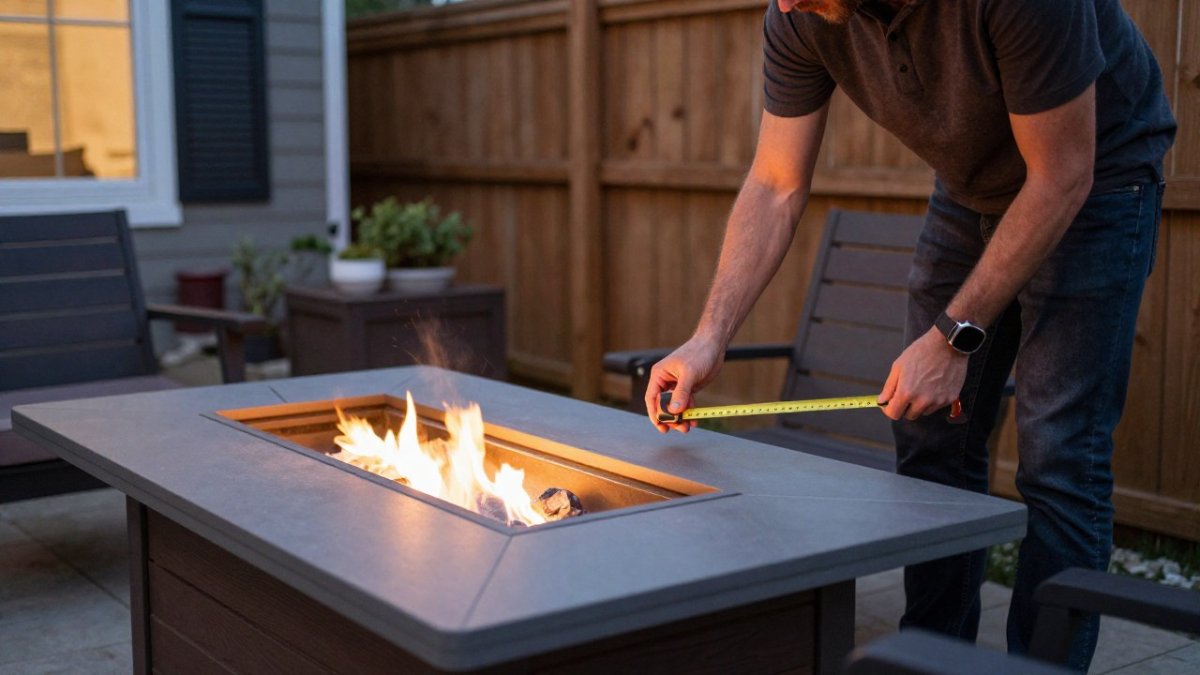
Gas fire pit safety rules begin before ignition. Check placement, clearances, and the surface under the unit every time you use it.
Placement: Level Ground and Minimum Clearances
Set your fire pit table on level, stable ground. A hard, flat surface like a paver patio or concrete pad keeps the unit from rocking.
Keep a safe distance from anything that can burn:
- At least 3 feet from walls, fences, and sheds
- At least 6 feet from low tree branches and awnings
- Clear of doorways and walkways
Always follow the manufacturer's stated minimum clearance. It overrides any general rule.
Overhead and Horizontal Clearance From Structures
Look up before you light. Overhead clearance matters as much as what sits beside the unit. Branches, roof overhangs, pergola slats, and awnings can catch heat and embers.
Check horizontal clearance too. A fire feature too close to a fence or shed traps heat and blocks airflow. Give the burner room to breathe. An open area with good ventilation is always the safer choice.
Choosing a Fire-Resistant Surface and Keeping Combustibles Clear
The surface under your fire pit should resist heat and stay stable. Concrete, stone pavers, and fire-rated composite decking are common picks. Avoid bare wood, dry mulch, and artificial turf.
Then clear the zone around the unit. Move these items well away:
- Paper plates, napkins, and tablecloths
- Dry leaves and pine needles
- Gas cans and lighter fluid
A simple habit helps: scan a 5-foot ring around the fire pit before every light-up. Wind can carry embers farther than you expect.
How Your Gas Fire Pit Remote Control Changes the Safety Routine
A gas fire pit remote control adds convenience, but it also adds a few steps. You are no longer standing at the unit when it lights, so you cannot see a failed ignition up close. The remote is a helper, not a replacement for watching the flame.
Keep the Unit in Line of Sight
Operate the remote only when you can see the burner and the flame. Line of sight lets you confirm ignition, spot a weak or yellow flame, and catch a failed light before unburned gas accumulates. If you cannot see the burner from where you are standing, walk to a position where you can before pressing any button.
Prevent Accidental Activation
A remote in a pocket or under a cushion can be pressed without your knowledge. Store the remote face-down on a shelf, in a drawer, or in a holster when it is not in use. Keep it out of reach of children and pets. If your system has a control lockout or child-lock function, engage it after every shutdown.
Check Batteries and Signal Before You Need Them
A weak battery can cause a delayed ignition or a remote that works intermittently. Replace remote and receiver batteries at the start of each season, and keep a spare set on hand. Test the remote from the farthest point you normally operate it to confirm the signal reaches the receiver. If the remote responds only when you are close to the unit, replace the batteries before the next use.
Verify the Flame Actually Ignited
After pressing the start button, watch the burner until you see a steady flame. Give it a few seconds, then confirm the flame is blue with a stable shape. If you see no flame, a sputter, or a flame that lifts off the burner, turn the remote off immediately and wait at least 5 minutes before trying again.
Store and Inspect the Remote and Receiver
Keep the remote dry and away from heat. A remote control receiver powers the ignition, so a damaged unit can behave unpredictably. Inspect the receiver, wiring, and battery compartment before each season, and replace any component with corrosion, cracked casing, or frayed wiring. Store the remote where it stays dry between uses.
Safe Lighting and Shutdown With a Remote Ignition System
Lighting a remote ignition system is quick, but the sequence matters. Follow these steps every time:
- Confirm the manual shutoff valve is open and the gas supply is on.
- Check that the area is clear and no one is leaning over the burner.
- Press the remote to start the electronic ignition.
- Watch for a steady flame within a few seconds.
- If it does not light, turn the remote off and wait at least 5 minutes for gas to clear.
- Stay nearby the entire time the fire pit operates.
Shutdown is just as important. Turn the unit off with the remote, then close the manual shutoff valve. Verify shutdown by checking that the flame is fully out and the burner has cooled. Never leave a fire feature unattended.
Follow this sequence every time you light or shut down a remote ignition system.
REMOTE, CF AUTOMATIC IGNITION SYSTEM →
| Step | What to do | Time or frequency |
|---|---|---|
| 1 | Confirm manual shutoff valve is open and gas supply is on | Every light-up |
| 2 | Check area is clear and no one leans over burner | Every light-up |
| 3 | Press remote to start electronic ignition | Every light-up |
| 4 | Watch for a steady flame | Within a few seconds |
| 5 | If it does not light, turn remote off and wait | At least 5 minutes |
| 6 | Stay nearby while the fire pit operates | Entire burn |
| Shutdown | Turn off with remote, then close manual shutoff valve | After every use |
Propane Fire Pit Specifics: Tank, Hose, and Leak Checks
A propane fire pit needs its own routine. Before each use, inspect the tank, hose, and regulator for cracks, wear, or loose connections.
Keep the tank upright and away from heat. If you need a replacement hose and regulator for a 20 lb tank, our LP regulator hose setup fits tanks up to 180K BTU.
Watch out: never use a flame to check for gas leaks. Soapy water is the safe test.
Gas Fire Pit Troubleshooting When Ignition Fails or the Flame Dies
Gas fire pit troubleshooting starts with a fixed sequence, not guesswork. The order matters because unburned gas is the main hazard when ignition fails. Work through these steps every time, and stop at the first sign of a gas smell.
Step 1: Stop the Gas and Wait
If the burner does not light, turn the remote off and close the manual shutoff valve. Wait at least 5 minutes for any gas that pooled in the burner or fire box to clear before you try again.
Watch out: if you smell gas at any point, do not press the remote, flip a switch, or use a phone near the unit. Close the tank valve, move people away, and follow the emergency steps below.
Step 2: Check Gas Flow
Confirm the manual shutoff valve is open and the tank is not empty. On a propane unit, check the tank level and inspect the hose and regulator for kinks, cracks, or loose connections. A common pattern is a tank that feels partly full but has lost pressure in cold weather. If the tank was recently refilled, the excess-flow device in the regulator may have tripped; close the tank valve, wait a minute, and reopen it slowly.
Step 3: Check the Igniter and Sensor
If gas flow is good, inspect the igniter and flame sensor. A dirty or misaligned sensor can shut the gas off shortly after ignition, which is why a flame that lights and then dies often points to the thermocouple or flame sensor rather than the gas supply. Clean the sensor with a soft cloth and confirm it sits in the flame path.
Step 4: Know When to Stop
Stop troubleshooting and call a qualified technician if you smell gas, cannot find the cause after these checks, see soot or discoloration on the unit, or hear a clicking that does not produce a spark. Do not disassemble the burner, valve, or control module beyond the steps in your manual. For a full walkthrough of spark, gas flow, and burner diagnosis, use our fire pit ignition troubleshooting guide.
Step 5: Relight Only After the Area Is Clear
Once the cause is corrected and the 5-minute wait has passed, relight from a position where you can see the burner. If the unit fails to light a second time, close the manual valve and schedule service rather than continuing to try. A repeated no-light condition is a signal, not a nuisance.
Emergency Response: Gas Leaks, Uncontrolled Flames, and Power Loss
If you smell gas, act fast. Shut off the manual valve and the tank. Move people away from the unit.
For an uncontrolled flame, shut off the gas supply first. Never throw water on a gas fire.
Power or remote failure needs a plan too. If the remote dies mid-burn, use the manual shutoff valve to stop the gas.
Build Your Fire Feature With the Right Remote and Shutoff Controls
The safest fire pit is the one built with safety controls from day one. A remote ignition system, a manual shutoff valve, and an emergency stop belong together.
Our remote CF automatic ignition system is designed for Crystal Fire direct spark ignition setups, priced at $149.99.

We stock fire pit components, with a price match promise and free shipping on orders over $50 in the lower 48 states.
Frequently Asked Questions
How do you safely turn on a remote control gas fire pit?
Open the manual shutoff valve at the gas supply first, then stand back and press the remote's ignition button. The direct spark or hot surface igniter should light the burner within a few seconds. If it does not light, turn the system off, wait at least five minutes for gas to clear, and try again. Never stand over the burner while igniting, and confirm the flame is established before walking away. Keep the remote stored away from children and out of the weather.
What should you do if a gas fire pit does not ignite?
Start with gas fire pit troubleshooting basics: confirm the shutoff valve is open, check that the propane tank is not empty, and inspect the battery in the remote or ignition module. If the burner still will not light after two attempts, stop and let the unit air out for five minutes before trying again. Repeated attempts without clearing gas can cause a flash. If ignition keeps failing, have a qualified technician inspect the igniter, thermocouple, and gas line.
Can you leave a remote control gas fire pit unattended?
No. A remote makes lighting convenient, but it does not make the fire self-monitoring. Stay within sight of the flame the entire time it burns, and keep children and pets at a safe distance. Wind can blow flames or embers toward combustible materials, and a flame that goes out can let gas accumulate. When you leave the patio, shut the fire pit off with the remote and close the manual shutoff valve.
How do you shut off a remote control gas fire pit safely?
Press the off button on the remote and watch until the flame is fully out, not just dimmed. Then close the manual shutoff valve at the gas supply so no gas can flow even if the remote is pressed accidentally. On a propane fire pit, this means turning the tank valve clockwise until it stops. Wait for the burner and surface to cool completely before covering the unit, and store the remote where it cannot be activated by children or rain.
Building a fire feature that lights with one press and shuts down with confidence takes the right controls, not just a pretty table. Urban Man Caves carries the ignition systems, shutoff panels, and fire pit components that make a remote gas fire pit safe and simple to run. Get started with Urban Man Caves and build a fire feature you can enjoy year-round.


