

Last Updated: November 2, 2026
Quick Summary
A portable outdoor cooler is worth it for people who spend regular time outdoors, host gatherings, or travel with perishable food. It is less worth it for occasional users who only need cold drinks for a single afternoon. Ask how many people you feed, how long each outing lasts, and whether the cooler will move.
- Hard-sided coolers resist punctures and rough handling better than soft-sided bags.
- Advertised ice retention is a best-case figure; sun exposure and opening the lid shorten it.
- Keep perishables below 40°F and verify with an appliance thermometer.
- Match capacity to group size and trip length, then check the loaded weight.
- Upgrade your cooler if it loses ice within hours or the lid no longer seals.
Table of Contents
- What Makes a Portable Outdoor Cooler Worth the Money
- Hard Cooler vs. Cooler Bag: Which Holds Up Outdoors
- How Long Do Coolers Keep Ice in Real Conditions
- Electric Coolers vs. Passive Ice Coolers: Power, Battery Drain, and Trade-offs
- Choosing the Right Cooler Size for Weekend Trips
- Total Cost of Ownership and Budget Alternatives
- Our Verdict: Buy, Skip, or Upgrade Your Current Cooler
- Frequently Asked Questions
What Makes a Portable Outdoor Cooler Worth the Money
Whether a portable outdoor cooler is worth it depends on how often you use it, where you take it, and how long you need food and drinks to stay cold. Homeowners building out a backyard for hosting often ask this question. A portable cooler is a useful tool, but it earns its price only when it solves a problem you actually have.
The short answer: a portable outdoor cooler is worth the money for people who spend regular time outdoors, host gatherings, or travel with perishable food. It is less worth it for occasional users who only need cold drinks for a single afternoon.
Start by asking three questions. How many people will you feed or drink for? How long does each outing last? And will the cooler sit in one place, or move between a patio, a boat, and a campsite? Your answers point toward the right capacity, insulation quality, and price point.
Premium coolers are often priced for durability and ice retention, since thicker insulation and rugged shells can hold temperature longer and resist cracks. Similar logic applies to the comfort of premium camping chairs, where the investment in structural integrity and ergonomic support often dictates whether your time spent outdoors remains restorative or becomes a test of endurance.
Key questions to answer before you buy:
- How many days per year will you use it?
- What is the longest trip it needs to cover?
- Does it need to be carried, or does it stay on a patio?
- How much food and drink must it hold?
Hard Cooler vs. Cooler Bag: Which Holds Up Outdoors
A hard-sided cooler generally holds up better than a soft-sided cooler bag in outdoor use, since a rigid shell resists punctures and rough handling.
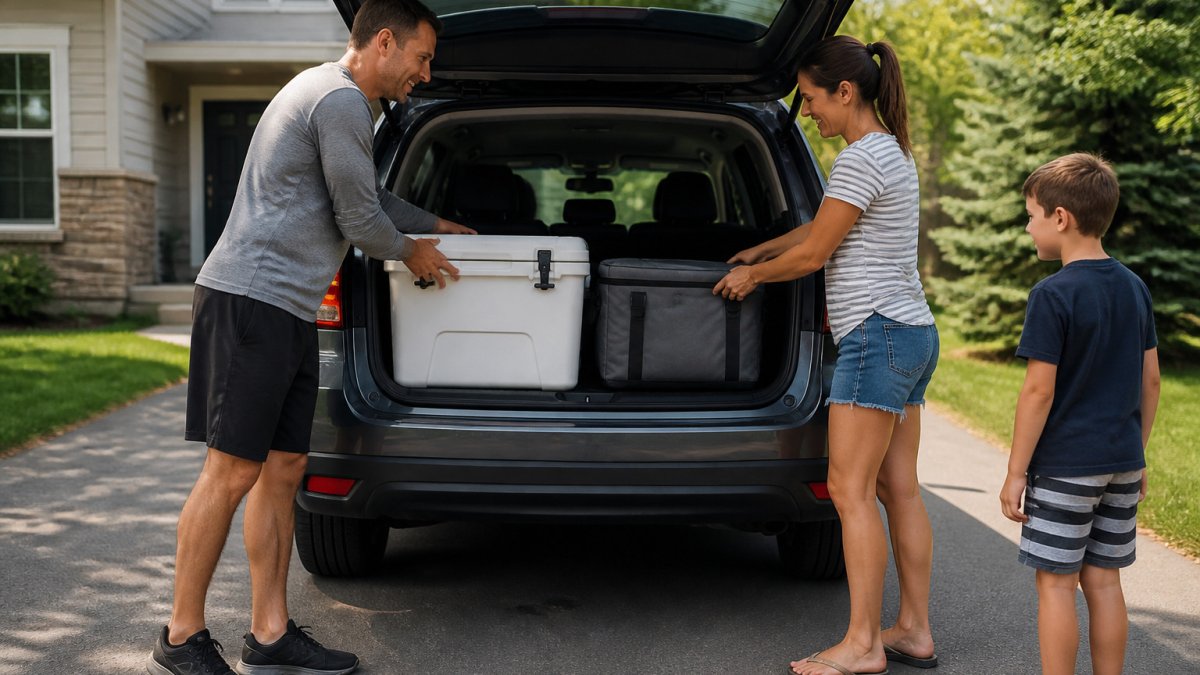
Soft-sided bags win on weight and storage. They fold flat, fit in a car trunk easily, and suit day hikes or short picnics. Many people keep a soft bag for quick trips and a hard cooler for the heavy-use occasions.
Watch out: a soft bag left in direct sun on a patio can lose its cold quickly, even when packed well. Keep it shaded and out of the car during hot afternoons.
!Family loading a hard-sided cooler and a soft cooler bag into the back of an SUV before a summer trip
How Long Do Coolers Keep Ice in Real Conditions
Advertised ice-retention figures are typically measured under controlled conditions. Real-world results are shorter, sometimes dramatically so. To judge whether a cooler is worth it, you need to translate the marketing number into the conditions you will actually use it in.
Here is the framework we use to think about real-world retention. Four variables drive most of the difference:
- Ambient temperature and sun exposure. A cooler sitting in direct summer sun on a patio can lose ice far faster than the same cooler in shade. Radiant heat loads the lid and walls, and dark-colored lids absorb more of it. If your cooler will live on a sunny deck, plan for meaningfully shorter retention than the label suggests.
- How full the cooler is. Ice cools the contents, but the contents also cool the ice. A cooler packed full of pre-chilled food and drinks holds ice much longer than one that is half empty, because the empty air space warms quickly every time the lid opens. Fill gaps with frozen packs or extra ice rather than leaving headroom.
- Ice type and starting temperature. Block ice melts more slowly than cubed ice because it has less surface area exposed to warm air. A common pattern is to use a block or a large frozen pack as the base layer and cubed ice on top for day-to-day access. Pre-chilling the cooler with a sacrificial bag of ice before loading also extends retention.
- Opening frequency. Every lid opening dumps cold air and pulls in warm, humid air. A separate small cooler or a divided compartment for drinks means the main lid stays closed, and that single habit often matters more than the cooler's insulation rating.
A practical way to test your own cooler is to run a baseline: pack it the way you would for a real trip, note the starting time and ice quantity, keep it in the conditions you actually use it in, and check the ice at set intervals without opening the lid more than necessary. That gives you a personal retention number you can plan around, which is more useful than any spec sheet.
For food safety, retention is not just about ice remaining, it is about contents staying at a safe temperature. Keep perishables below 40°F, and use a simple appliance thermometer in the cooler to confirm rather than guessing. If you cannot verify the temperature, treat the cooler as a short-term solution and replenish ice sooner.
We recommend planning for less time in summer heat and more in cooler weather, and sizing your ice supply to the trip rather than trusting the label.
The article breaks down the four variables that drive real-world ice retention.
| Variable | Effect on ice | Practical tip |
|---|---|---|
| Sun exposure | Dark lids absorb radiant heat, shortening retention | Keep cooler in shade |
| How full it is | Empty air space warms fast | Fill gaps with frozen packs |
| Ice type | Block ice melts more slowly than cubed | Use block base, cubed on top |
| Opening frequency | Each opening lets warm air in | Use a separate drinks cooler |
| Food temperature | Perishables must stay below 40°F | Verify with an appliance thermometer |
Electric Coolers vs. Passive Ice Coolers: Power, Battery Drain, and Trade-offs
Electric coolers keep contents at a set temperature without melting ice, which makes them attractive for long trips. The tradeoff is power. They draw from a battery or outlet, so you need a charging plan, and a drained battery means warm food. Passive ice coolers need no power but require ice, which you must buy or freeze and which melts over time.
Glass Front Outdoor Beverage Cooler →
Choose an electric cooler if you have reliable power access or a vehicle that can run it. Choose a passive cooler if you camp in remote areas or want a simpler, lower-cost setup.
Watch out: an electric cooler running on a car battery can drain that battery if the engine is off for long periods. Monitor the battery level or use a cutoff feature if your model offers one.
Choosing the Right Cooler Size for Weekend Trips
Cooler capacity is usually quoted in quarts, and the right size depends on three inputs: how many people you are feeding, how many days the trip lasts, and how far you have to carry the cooler once it is loaded. Treating portability as a vague benefit is how people end up with a cooler that is too heavy to move or too small to hold a weekend's food.
A useful starting framework:
- Day outing, two to four people, drinks and lunch. A smaller cooler in the 20- to 30-quart range is usually enough, and it stays light enough to carry from the car to a picnic table or boat in one trip.
- Weekend trip, two people, food and drinks. A 30- to 50-quart cooler is the common sweet spot. It holds a weekend's perishables plus ice without becoming unmanageable when loaded.
- Weekend trip, four or more people, or a longer road trip. Step up to a larger hard cooler, but plan on two people to move it when full, or keep it vehicle-based rather than carrying it to a campsite.
The trade-off is loaded weight. A full cooler is heavy, ice and drinks add substantial weight on top of the empty cooler, and the larger the capacity, the more that weight grows. If you have to carry the cooler any real distance, a smaller cooler carried twice, or a soft-sided bag for the hike-in portion plus a hard cooler left at the vehicle, often works better than one oversized hard cooler.
Oversizing has a hidden cost: empty space warms faster than packed space, so a half-full large cooler loses ice sooner than a properly filled smaller one. Pack the cooler reasonably full, and use smaller containers or frozen packs to fill gaps when you are carrying a lighter load.
For buyers who want a premium look and performance without a full outdoor kitchen investment, our catalog includes the Glass Front Outdoor Beverage Cooler, listed at $1,946.00. It is built for stationary entertaining rather than portable trips, so it suits a patio bar more than a camping cooler.

If portability matters more, a well-built hard cooler at a lower price point may serve you better. Compare the features you truly need against the price before deciding.
Total Cost of Ownership and Budget Alternatives
The purchase price is only part of the cost. Factor in ice or pack replacements, batteries for electric models, and replacement parts such as gaskets or latches. A cheaper cooler that fails after one season often costs more over time than a durable one.
For buyers who want a premium look and performance without a full outdoor kitchen investment, our catalog includes the Glass Front Outdoor Beverage Cooler, listed at $1,946.00. It is built for stationary entertaining rather than portable trips, so it suits a patio bar more than a camping cooler.
If portability matters more, a well-built hard cooler at a lower price point may serve you better. Compare the features you truly need against the price before deciding.
The Black Diamond Outdoor Refrigerator RH, priced at $1,237.00, offers a four-cubic-foot cooling zone for grill islands and perimeter cabinets.

For permanent outdoor kitchen installations, the ICE MAKER, HI-CAPACITY is listed at $5,975.00.

Our Verdict: Buy, Skip, or Upgrade Your Current Cooler
Buy a portable outdoor cooler if you host regularly, travel with food, or need reliable cold storage away from the house. Skip it if you only need cold drinks a few times a year. Upgrade your current cooler if it loses ice within hours or the lid no longer seals.
If you are building a permanent outdoor entertaining space, Urban Man Caves offers personal expert support to help compare built-in and portable options. Shop all products to find the right fit for your backyard.
Frequently Asked Questions
Do small portable air coolers work?
Small portable air coolers work best in small, enclosed spaces and cool the air only a few degrees. They do not replace an ice-based cooler for keeping food cold. For food and drinks outdoors, a passive ice cooler or a dedicated electric cooler performs far better. Air coolers are a reasonable choice for personal comfort on a porch or in a camper, but expect modest results in high ambient heat.
Are expensive coolers worth the extra cost?
Higher-priced coolers are usually worth it if you use a cooler often, take multi-day trips, or need to keep food safe for long stretches. Premium models typically offer thicker insulation, more durable hinges and latches, and better seals, which translate into longer ice retention. For occasional day use, a mid-priced cooler often delivers most of the same benefit at a lower cost.
What size portable cooler do I need for a weekend trip?
For a weekend trip for two people, a cooler in the 25 to 45 quart range usually holds enough food, drinks, and ice for two to three days. Plan for roughly half the cooler volume as ice and the rest as food and drinks. Larger groups or longer stays call for a bigger cooler, and a second small cooler for drinks can keep the main cooler from being opened constantly.


